Day 1: Arrive in Tokyo.
Arrive at Tokyo.
If you have booked an arrival transfer through us, then our assistant will meet you just outside of the secure area, and they will take you to the hotel by private van transfer.
Check into the hotel and relax.
Arrival time is scattered this evening, so have a good rest, ready for the week ahead.
Overnight: Mitsui Garden Hotel Ginza Premier.
Day 2: Tokyo – New & Old
*Our luggage will be forwarded to Takamatsu this morning.
We meet this morning for breakfast to say hi to each other, and to go over our upcoming journey. After breakfast, we embark on a full-day tour to discover some of the complex and rich culture, history, and society that underlie the city.
We catch the train to the charming neighborhood of Yanaka Ginza. Yanaka Ginza retains the nostalgic charm of old Japan while still buzzing with the energy of the present. Often referred to as one of Tokyo’s “shitamachi” (literally means lower town), it is a district that offers a glimpse into the city’s past, a world away from the high-tech modernity and neon lights you might associate with Tokyo. From beautiful temples and historic cemeteries to the bustling shopping street filled with local vendors selling traditional Japanese goods, there’s so much to love and explore here.
We visit Nezu Shrine, one of Japan’s oldest shrines, set in lush greenery with ponds of carp, pathways that are tunnels of small shrine arches, and elegant, beautifully colored, wooden structures that reflect Japanese culture in all its age and beauty.
In the afternoon, we return to the Ginza district, where we are staying. (And an option to call it a day and head back to the hotel.) You’ll find magnificent examples of architecture all over the city, but the upscale neighborhood of Ginza is the mecca of modernist Tokyo architecture. It centers around a major avenue called Chuo-dori, which some call the 5th Avenue of Tokyo: a broad street lined with high-end fashion stores, each trying to outdo one another with impressive displays and buildings. You can visit a depachika, shop at Ginza 6, stop at Itoya, one of the city’s most beautiful and well-stocked stationary shops, and shop at the Muji Super Store or the UniQlo Flagship Store. You can take some time to walk past the likes of Nissan Crossing, Ginza Place, Louis Vuitton Ginza, Hermes, Mikimoto Ginza, and Yamaha Ginza.
Return to the hotel for a good night’s rest. Your evening is free.
Overnight: Mitsui Garden Hotel Ginza Premier (B / L)
Day 3: Tokyo to Takamatsu
After breakfast, we transfer to the train station for our Shinkansen to Okayama. In Okayama, we switch to the Rapid Mariner Train headed for Takamatsu, on Japan’s fourth largest island, Shikoku. The Rapid Marine Liner runs directly to Takamatsu across the scenic Seto-Ohashi Bridge, over the Seto Island Bridge. And the views from the train are amazing!
We walk to our hotel (about a 2-minute walk), check-in, and refresh.
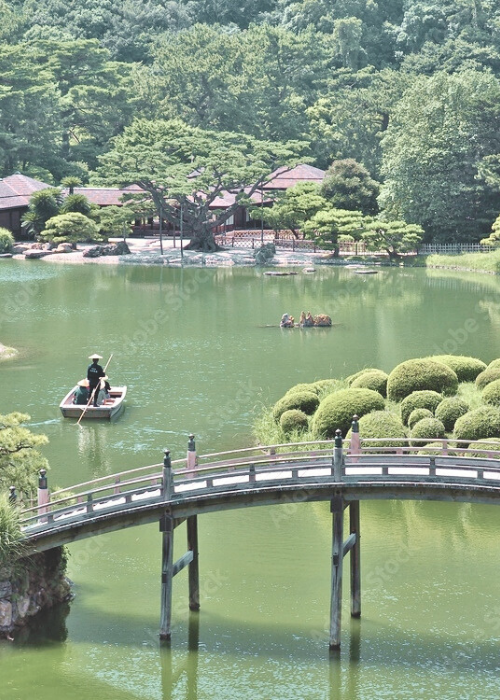
We are then picked up by our van and whisked off to the incredible Ritsurin Garden. Ritsurin Garden is the largest Cultural Property Garden in all of Japan and has been maintained for nearly 400 years. The garden features six ponds and thirteen landscaped hills in front of the green vista of Mt. Shiun. Seasonal flowers and one thousand carefully maintained pine trees create gorgeous scenery that changes throughout the seasons. We will have a cup of matcha tea at the Kikugetsutei teahouse, view old tools and crafts at the on-site Sanuki Folk Craft Museum, and take a private Wasen boat ride that circle the garden’s South Pond.
We then return to our hotel.
Tonight, we dine in-house and get a good night’s sleep to prepare for our Naoshima adventure.
Overnight: JR Clement Hotel (B / L – Bento Box / D)
Day 4: Naoshima
Today, we go by ferry to Naoshima Island, which has gained international acclaim for its remarkable fusion of contemporary art, stunning architecture, and serene coastal landscapes. (We are picked up by our Private Van). NOTE: Your do not need to be an art aficionado, you can simply appreciate the union of art, architecture and nature.
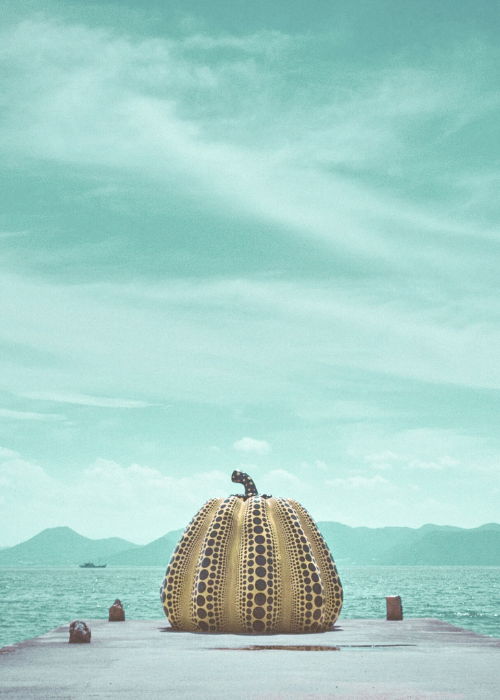
Arriving at Miyanoura Port we are met by Yayoi Kusama’s iconic Red Pumpkin sculpture.
We wander a favorite—the Art House Project. In this project, artists take empty houses scattered about residential areas and turn the spaces into works of art, weaving in history and memories of the period when the buildings were lived in and used. Going from one of the houses to another, everyday life unfolds around you; in the process, you not only engage with works of art but also sense the layers of time and history interwoven in the community and the fabric of local people’s lives.
Lunch will be at a secluded, home-like café in a refurbished traditional farmhouse.
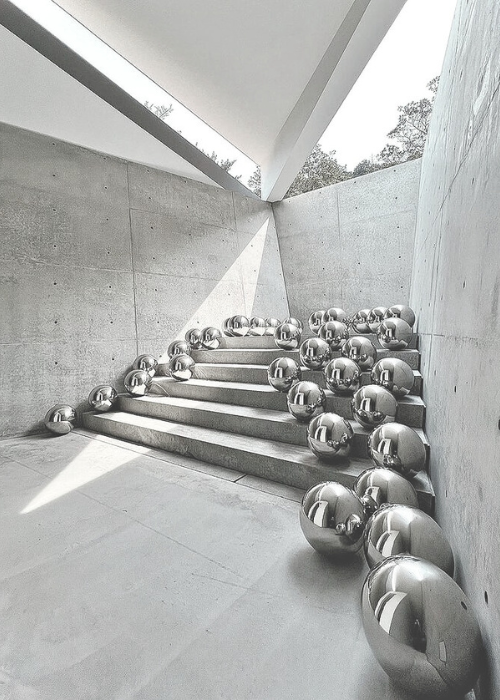
We will visit the Naoshima New Museum of Art, designed by Tadao Ando, his tenth architectural work among the art facilities of Benesse Art Site Naoshima, and an incredible addition to the island.
We return to Takamatsu in the afternoon on the ferry. After a fabulous, day your evening is free.
Overnight: JR Clement Hotel. (B / L)
Day 5: Naoshima
This morning, we board our ferry back to Naoshima. Again, we have a Private Van to ferry us around the island.
We start with, of course, Yayoi Kusama’s famous giant yellow pumpkin.
We then visit the standouts: the Chichu Art Museum, designed by architect Tadao Ando, and the Chichu Garden, designed as a homage to Claude Monet’s Giverny. The Lee Ufan Museum, a museum resulting from the collaboration between internationally acclaimed artist Lee Ufan, and architect Tadao Ando. Located in a gentle valley surrounded by hills and the ocean, the museum offers a tranquil space where nature, architecture and art resonate, inviting peaceful and quiet contemplation in a society overflowing with material goods. We pop over to Valley Gallery, built in a valley that has been considered a sacred space since ancient times.
We stop for lunch at Issen restaurant in the Benesse House Museum and then have the opportunity to wander around. The museum features contemporary artworks displayed in various indoor and outdoor spaces where we can admire works by acclaimed artists such as Jean-Michel Basquiat, Yayoi Kusama, and David Hockney.
We drop into the Hiroshi Sugimoto Gallery, and ‘The Corridors of Time’, a piece that encourages visitors to walk around the architecture space in its natural environment.
We return to Noashima by ferry and to our hotel. Another lovely day, your evening is free.
Overnight: JR Clement Hotel. (B, L)
Day 6: Teshima Art Island
This morning, we board our ferry to Teshima Island. Again, we have a Private Van to ferry us around the island.
What once was a rural island suffering from depopulation has been revitalised by the Setouchi Triennale Art Festival and several museums built on Teshima. It offers stunning coastal views, rolling hills, and vibrant flora.
We visit sites including Yokoo House and Beyond the Border.
We eat lunch at a restaurant with an ocean view that offers popular fare made with a wide variety of Teshima Island ingredients.
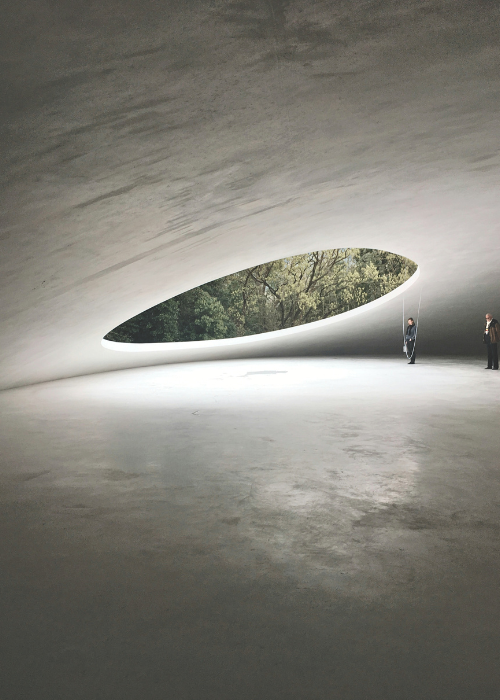
One of the main highlights of Teshima is the Teshima Art Museum, a remarkable architectural and artistic creation nestled within a hillside. Designed by Ryue Nishizawa and Rei Naito, the museum combines the natural environment with innovative design. Standing amongst terraced rice fields, the simple concrete structure stimulates its visitors’ senses with the play of water drops on a concrete surface.
We return to Takamatsu by ferry and to our hotel. This evening we meet in the bar before heading out to dinner.
Overnight: JR Clement Hotel. (B, L)
Day 7: To the Iya Valley
After breakfast and check-out, we transfer to the Iya Valley. The Iya Valley’s location deep in the mountains of Shikoku has kept it far off the beaten path, rewarding those who come with unspoiled natural scenery, narrow river gorges, rustic vine bridges and relaxing hot springs. It is one of the most remote places in all of Japan.
Just outside of Takamatsu, we will visit Takumikumo Village to explore a forest of exquisite bonsai trees and, hopefully, leave with a newfound understanding of the philosophy, skill and patience needed to create these living masterpieces. It is the base of Takumikumo, a group of craftsmen who specialize in bonsai, a traditional culture of Kagawa Prefecture, as well as pottery, Kagawa lacquerware, Aji stone, and more. We will have a guided tour of the nursery, and then enjoy tea and sweets surrounded by stunning works of art.
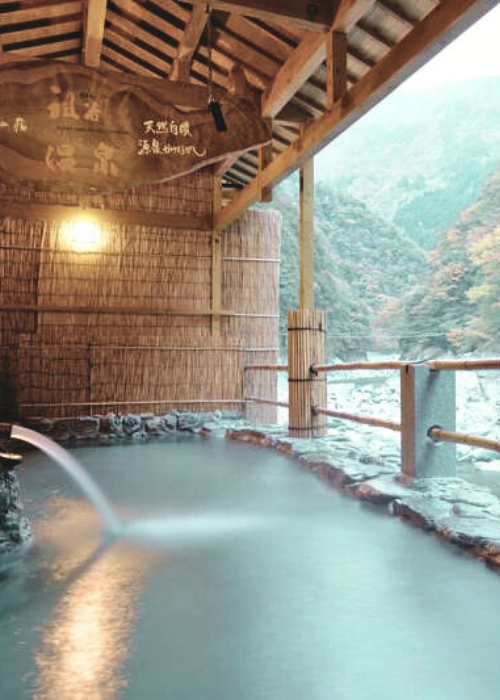
We continue to Hotel Kazurabashi, a traditional hot spring resort nestled in the valley’s heart, where you can soak in the therapeutic waters and indulge in authentic Japanese hospitality. Kazurabashi is nestled amidst lush green mountains and offers a traditional Japanese onsen experience, complete with hot spring baths that offers a panoramic view of the Iya Valley, accessible by a cable car to the mountaintop. Stroll around in your yukata robe, unwind in an outdoor or indoor public hot spring bath, or rent a bath for private use.
Once we check in, there is time to relax before dinner. Get changed into your Yukata, book your Onsen session, relax in your room, and prepare for dinner. During your time here, you’ll relax, soak up the minerals, and walk away healthy and refreshed.
Dinner this evening is in-house. The evening course is a multi-course meal that includes appetizers, a variety of dishes, sashimi, grilled dishes, fried dishes, meat dishes, and desserts. *The menu changes with the seasons to make the most of seasonal ingredients.
Overnight: Hotel Kazurabashi (B / L / D)
Day 8: Iya Valley
Today is day to enjoy our local surroundings, and then simply relax.
This morning we take a quick transfer to the Oboke Gorge, where we jump on a 30-minute sightseeing cruise along the clear waters of the Yoshino River. Obokechoboke, designated as a national scenic spot, was formed by the erosion of the Yoshino River, and has been created by nature over 200 million years. From the boat, we can enjoy the beauty of this deep ravine, its conglomerate schist (designated as a natural treasure by Tokushima Prefecture), and the beauty of the ravine.
We have lunch at Cafe Oboke or Cafe & Jibie overlooking the Gorge.
This afternoon is all relaxation: open air hot spring baths, soothing your muscles and relaxing in a scenic setting. Built on the side of the mountain, a cable car takes you up and down to the open-air bath along the river flowing through the valley. The Iya Valley area has had hot springs gushing out since ancient times, and legend has it that the Heike clan discovered these hot springs when they entered the mountains of Iya and took a cure in the hot springs. You can bathe in an open-air bath jutting out into the valley, and listen to the sound of the babbling river in the background, or in an indoor bath with no boundary between inside and outside.
We dine in house again this evening.
Overnight: Overnight: Hotel Kazurabashi (B / L / D)
Day 9: To Takamatsu.
After breakfast, we check out and prepare for our journey back to Takamatsu.
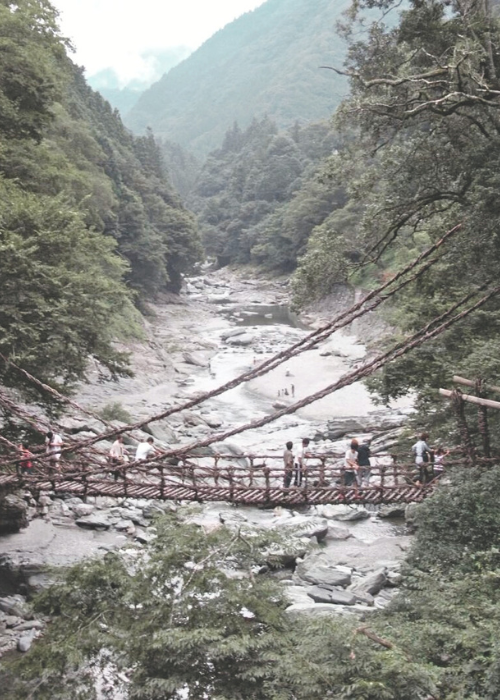
This area of the Iya Valley used to have 13 kazurabashi (vine suspension bridge) for valley dwellers to use. Only two of the bridges that cross the valley still stand today. This morning we visit Iya Kazurabashi, one of surviving vine bridges. After crossing the vine bridge, many visitors like to walk past the Biwa no Taki waterfall and take the steps down to the river below.
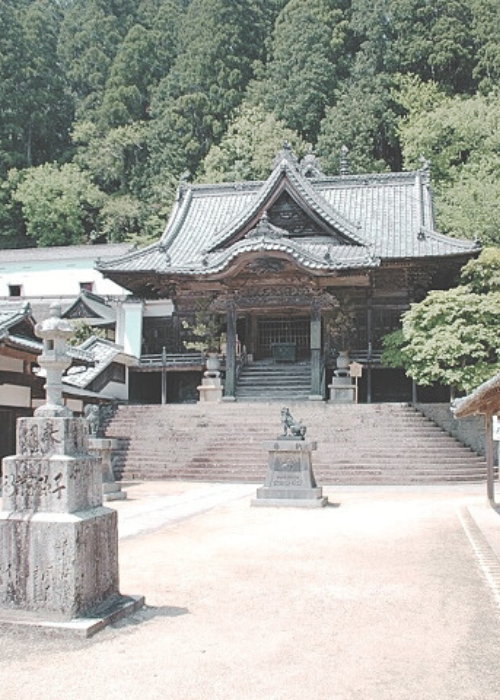
We also stop to see Hashikura Temple, (the 15th Bekkaku Temple) a thousand-year old temple situated along the 88 Temple Pilgrimage through Shikoku, one of Japan’s most famous pilgrimage routes, and one of few religious sites at which traditions from Shinto and Buddhism sit side by side. Hashikura-ji is a National Tangible Cultural Property and mountaintop temple that is accessed via the Hashikurasan ropeway. *Note: The ropeway journey takes you to the base of the temple, then you need to climb several hundred steps beyond to bring you to the temple grounds.
We continue to Takamatsu and check into our hotel.
We can meet in the bar this evening for a cocktail before dining together for our last meal in Shikoku.
Overnight: JR Clement Hotel (B / L / Farewell Dinner)
Day 10: Depart
Your final day. Time to say farewell, Arigatou Gozaimashita. (B)
Enjoy a lazy breakfast, and then prepare for your transfer to the airport or walk to the train station.
*Transfer to Takamatsu airport to board your Domestic flight, connect with International, or carry on elsewhere in Japan.
*Walk to Takamatsu train station to board your train back to Osaka, Kyoto, or Tokyo, or to carry on elsewhere in Japan.
*Departure transfers to the airport are not included, as guests depart at different times.
*We will help arrange transfers, and match up guests departing at the same time.